
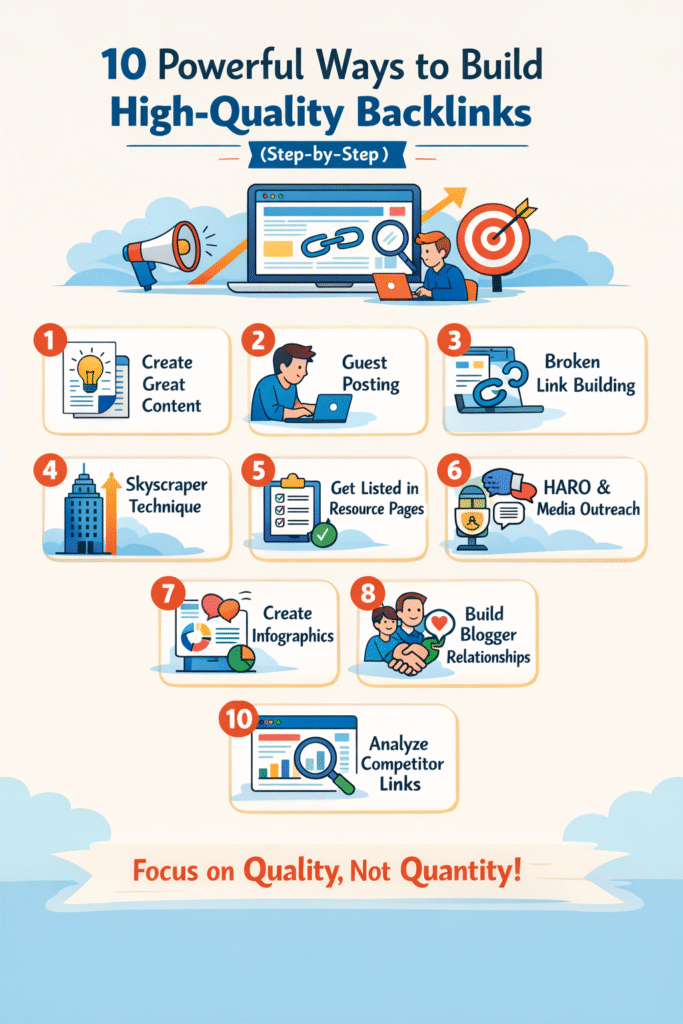
10 Powerful Ways to Build High-Quality Backlinks (Step-by-Step)
If your website is still not visible, do you still want to rank on Google?
You release content. You research keywords. No traffic yet. Why?
Backlinks are a major factor.
Links to your website from other websites are known as backlinks. They are regarded as trust signals by Google. Google considers your website valuable if it has links from other high-quality websites.
However, not every link is good. Certain links may even cause harm to your website. The true query then becomes: How can one safely and methodically Build High-Quality Backlinks ?
I’ll show you ten effective methods in this guide. These techniques are easy to learn, realistic, and straightforward. You can begin right now.
Before we begin, keep this in mind: Prioritize high-quality backlinks over quantity. A single link from a reliable website is preferable to 100.
Now let’s begin,
1.How to Write Content That Gets High Quality Backlinks
The first step is straightforward but effective. Make content that people want to link to.
Why would someone link to your article, you ask? Does it resolve an issue? Does it provide a better explanation than others?
Write comprehensive manuals. Give examples. Utilize actual data. Describe the procedures in detail.
We refer to this as linkable content. Over time, it acquires organic backlinks on its own.
- You are able to produce
- Ultimate manuals
- Examples of cases
- Posts about statistics
- Free resources
- Original investigation
Other bloggers will use your content as a reference if it is helpful. Natural link building operates in this manner.
2.Guest Posting to Build High-Quality Backlinks Safely
If done properly, guest posting is still effective.
Look for blogs related to your field. Verify that they have active readers, genuine traffic, and a strong domain authority.
Send them a brief proposal. Avoid writing lengthy emails. Be courteous and explicit.
Provide value. Make a topic suggestion that will benefit their audience. Avoid creating poor-quality content merely to obtain a link.
Include one pertinent link to your website within the article. We refer to this as a contextual backlink.
Guest posting is beneficial for:
Developing authority
Increasing recognition of the brand
Receiving traffic from referrals
Prioritize high-quality websites over link farms.
3.Broken Link Building for High-Quality Backlinks
Make Use of Broken Link Building
This approach is effective but rarely used.
Finding broken links on other websites and providing your content as a substitute is known as broken link building.
Here’s how:
Look for websites in your niche first. Make use of free broken link checkers or Ahrefs.
Keep an eye out for pages with broken links. When you locate one, see what the previous content covered.
Next, produce better content about the same subject. Inform the owner of the website about the broken link in a courteous manner.
Provide your link as a useful substitute.
This approach is effective because you are assisting them in resolving a problem. It provides you with a high-authority backlink and enhances their user experience.
4. Use the Skyscraper Technique to Develop Backlinks
The Skyscraper Technique is easy to understand.
Step 1: Look for well-liked content with a lot of backlinks in your niche.
Step 2: Produce an improved product. Make it more current, longer, and more lucid.
Step 3: Contact the websites that have links to the previous content.
Inform them that you have a revised version. Request that they examine it.
If your content is really better, many will replace the old link.
This technique creates effective backlinks and raises your search engine ranking.
But keep in mind that your content needs to be ten times better. Not just a little bit better.
5. Become Included on Resource Pages
Resource pages can be found on many websites. These pages provide a list of useful resources, blogs, and manuals.
Do a Google search:
“Your keyword” plus resources “Your keyword” plus helpful links “Your keyword” plus suggested websites
Verify that your content is appropriate for the resource page you have located.
Write a brief email. Describe the value of your content.
Many website owners will include your link if your article is genuinely valuable.
This raises the authority of your website and creates powerful white hat backlinks.
Now let’s go deeper.
Building backlinks is more than just obtaining links. It is about establishing trust and relationships.
Let’s investigate more potent tactics.
6. Make Use of Journalist and HARO Platforms
HARO stands for “Help A Reporter Out.”
Journalists search for quotes from experts. They might use your quote in their article if you respond with insightful responses.
And you know what? News websites provide you with a backlink.
Join journalistic networks such as HARO.
Select subjects that are relevant to your specialty. Respond quickly. Be succinct and clear.
High-authority websites may backlink to you if your response is chosen.
This improves your Google ranking, brand credibility, and SEO strategy.
7.Create Infographics and Visual Content
People adore images.
Infographics are simple to share and comprehend. Bloggers might use your infographic on their websites if it contains valuable data.
They typically provide a backlink to acknowledge its use.
Make graphics that are clear, uncomplicated, and educational. Make use of actual statistics and data.
Below your infographic, include an embed code. With a backlink, this makes it simple for others to copy and paste.
Visual content draws in natural links, boosts shareability, and enhances content marketing.
8. Use Internal Linking Smartly
Links from one page on your website to another are known as internal links.
They aid in distributing link power throughout your website even though they are not external backlinks.
Submit your website to trusted directories like:
- Google Business Profile
- Yelp
- Bing Places
Internal links transfer some value to other pages when you receive a strong backlink to one page.
Make use of anchor text that is descriptive. Only include links to pertinent pages.
This enhances crawlability, site structure, and on-page SEO.
Clear internal links help Google better understand your website.
10. Make Use of Business Directories and Local Citations
Local citations are very beneficial if you own a business.
Verify that your name, address, and phone number (NAP) are all the same.
Local backlinks enhance local search engine optimization, particularly when focusing on a particular city.
But stay away from spam directories. Use only platforms that you can trust.
HERe some Extra tips
11. Publish Case Studies and Original Data
Original data attracts links.
If you run surveys or share real results, bloggers may reference your data.
For example, “We tested 100 websites and found this result.”
People love statistics.
Add charts. Add screenshots.
This builds strong authority backlinks and improves E-E-A-T (Experience, Expertise, Authority, Trust).
Google values real experience.
12. Use Roundup Posts to Build High-Quality Backlinks
Roundup posts mean collecting expert opinions.
Example: “20 Experts Share Their Best SEO Tips.”
Invite experts to share short tips. Publish them in one article.
When the post is live, inform them.
Many experts will share and link to the article.
This increases traffic and builds backlinks naturally.
These methods require effort but give strong results.
13. Repurpose Content on Medium and LinkedIn
You can republish your content on platforms like Medium or LinkedIn Articles.
Add a note that the original article is on your website.
This builds visibility and sometimes referral backlinks.
It also increases your content distribution and brand reach.
But always use canonical links if possible.
14. Create Free Tools or Templates
Free tools attract backlinks.
For example:
- SEO checklist
- Keyword research template
- Budget calculator
When people find tools helpful, they link to them.
Tools increase user engagement and build long-term backlinks.
Even a simple downloadable PDF can work.
15. Monitor Competitor Backlinks
Your competitors already have backlinks.
Why not learn from them?
Use SEO tools to analyze their backlink profile.
Check where they got links from.
Reach out to the same websites with better content.
This improves your competitive analysis and speeds up link building.
16. Use Testimonials for Backlinks
Many companies publish customer testimonials on their website.
If you use a tool or service, write a genuine testimonial.
Often they will publish it with your name and website link.
This is easy and powerful.
It builds brand signals and strong backlinks.
17. Recover Lost Backlinks
Sometimes websites remove your link by mistake.
Use tools to track lost backlinks.
If you see a lost link, contact the website owner politely.
Ask if they can restore it.
Also check for mentions without links. If someone mentioned your brand but did not link, request them kindly.
This improves your backlink profile and protects your SEO.
Important Things to Avoid
Do not buy backlinks from spam websites.
Do not join private blog networks.
Do not use automated link software.
These are black hat methods. They may give short-term results but can cause Google penalties.
Always focus on white hat SEO, value, and trust.
Review
Backlink building is not magic. It is strategy and patience.
Ask yourself: Are you creating real value? Are you building relationships? Or are you just chasing links?
Focus on quality content. Use guest posting smartly. Try broken link building. Build real connections.
Remember, SEO is long-term.
If you apply even 5 of these methods correctly, you will see growth in traffic, authority, and rankings.
Start small. Stay consistent. Improve every month.
Now tell me, which backlink strategy will you try first?